Training & safety · Word + PDF + Excel
Tire Service SOP & Safety Checklists
Write down how your bay does the work, check every lift every shift, and know who's cleared to work alone.
What it does
Most tire shops run on "the way we've always done it". That works until a new tech starts, a lift inspection slips past its due date, or a wheel comes back loose and nobody can show what was checked.
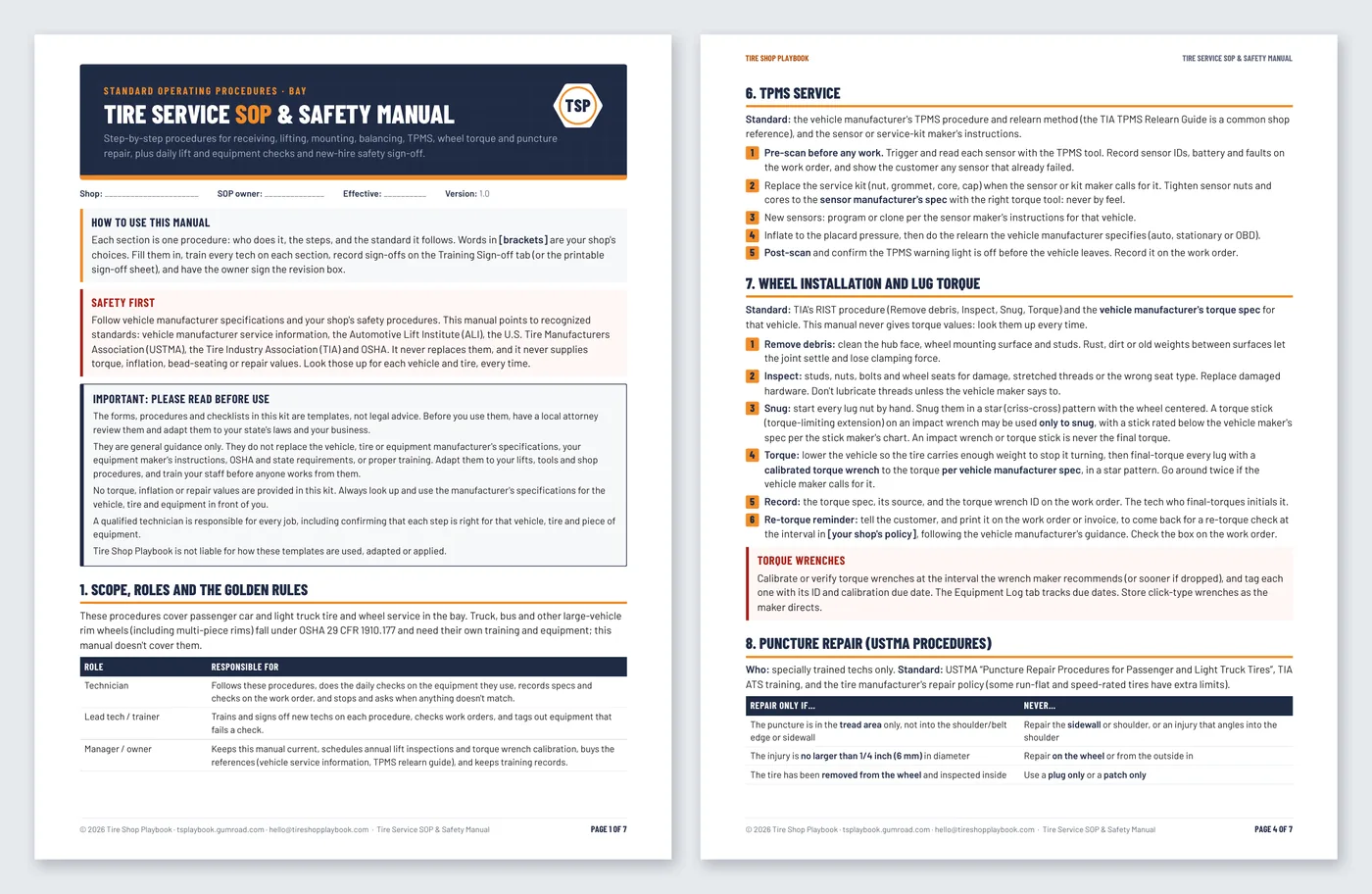
This kit gives you a written shop procedure manual for the tire bay, printable checklists your techs initial on the job, and a Safety Log spreadsheet that keeps the records. Every procedure points to a recognized source: the vehicle manufacturer's service information, ALI's "Lifting It Right" and the ANSI/ALI ALOIM daily lift checks, TIA's RIST wheel-install procedure, and the USTMA puncture repair procedures. Where a number matters (torque, inflation pressure, lift points), the manual tells your tech where to look it up, every time. It never prints a number for them to trust instead.
It's built for owners and shop managers who need a starting point they can adapt, not a binder nobody reads. Edit the Word file to match your equipment and procedures, have a local attorney adapt it, and print.
What it helps you do:
- Write it down once: 13 sections covering roles and golden rules, receiving and stocking (DOT codes, tire-age policy per manufacturer guidance), lifting, dismount and mount, balancing, TPMS, wheel install and torque, puncture repair, daily checks, new-hire safety, stop-and-ask rules, references and a revision history.
- Torque it right: torque sticks only to snug; final torque with a calibrated torque wrench to the vehicle manufacturer's spec, in the star pattern; a re-torque reminder for the customer, per your shop policy.
- Repair punctures the industry way: tread area only, injury size within USTMA's limit (check the USTMA chart posted in the bay), tire off the wheel, plug and patch from the inside, and the cases where a tire can't be repaired (per USTMA).
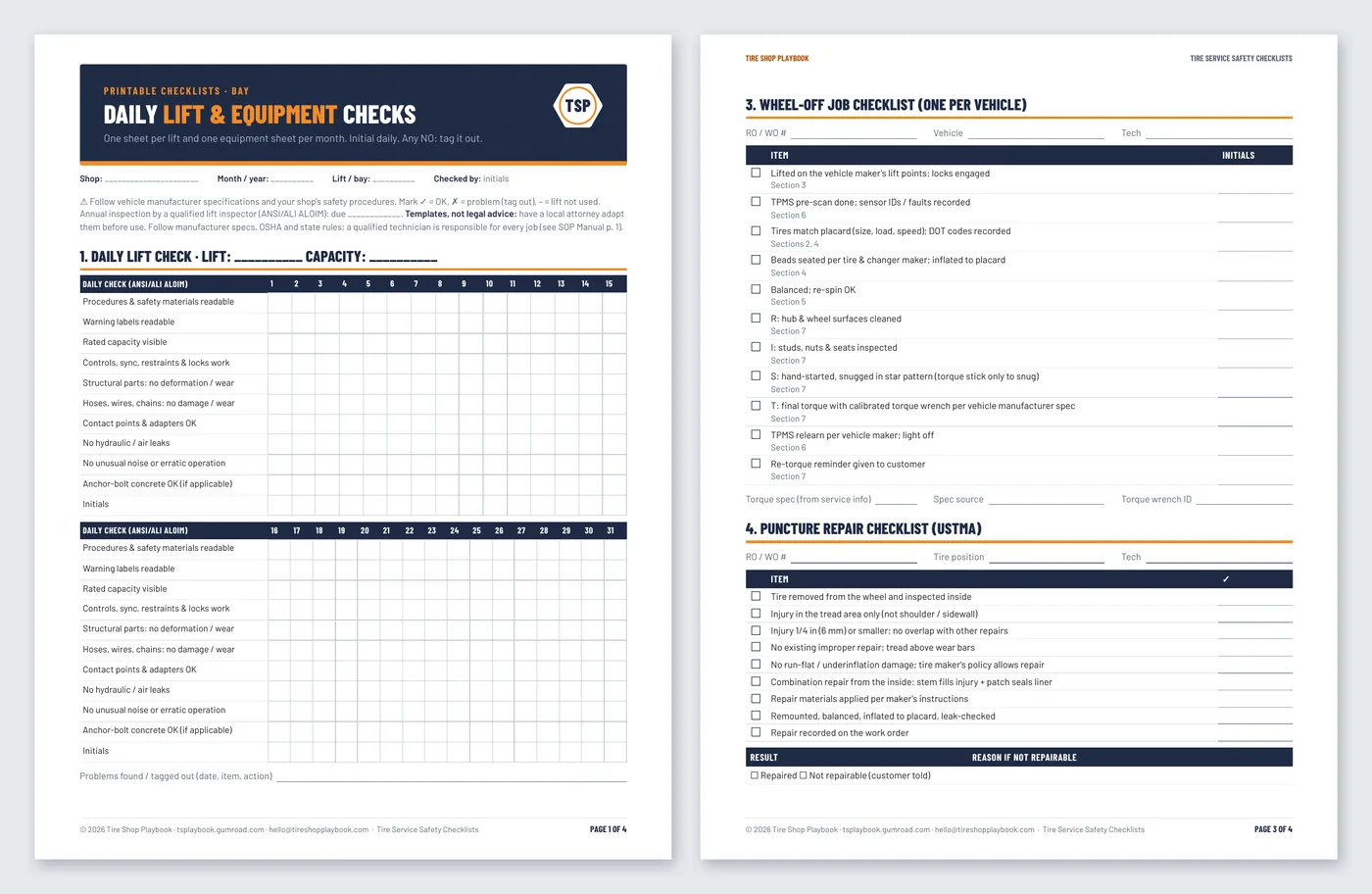
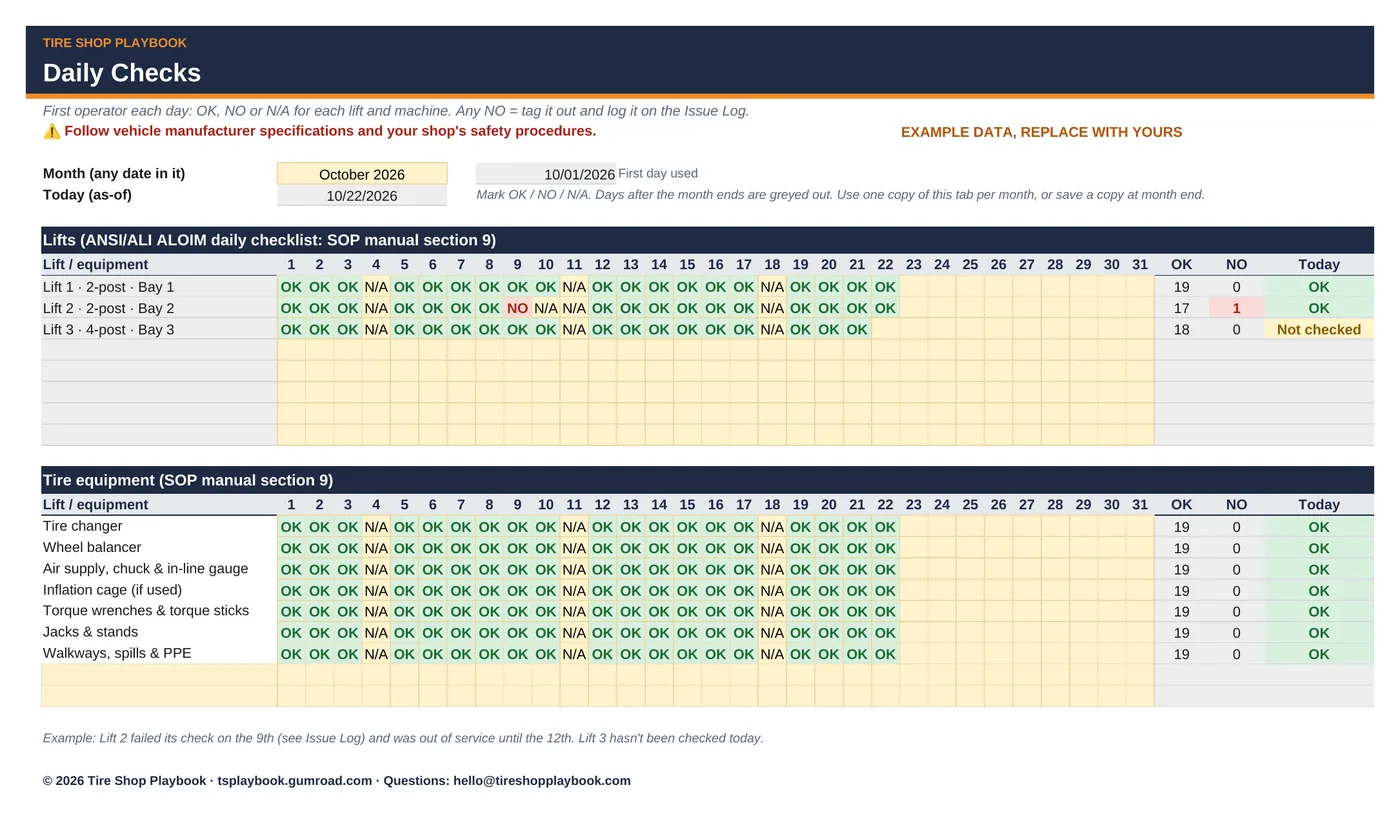
- Check every lift, every shift: a monthly daily-check grid for up to 8 lifts and your tire equipment. Any NO means tag it out.
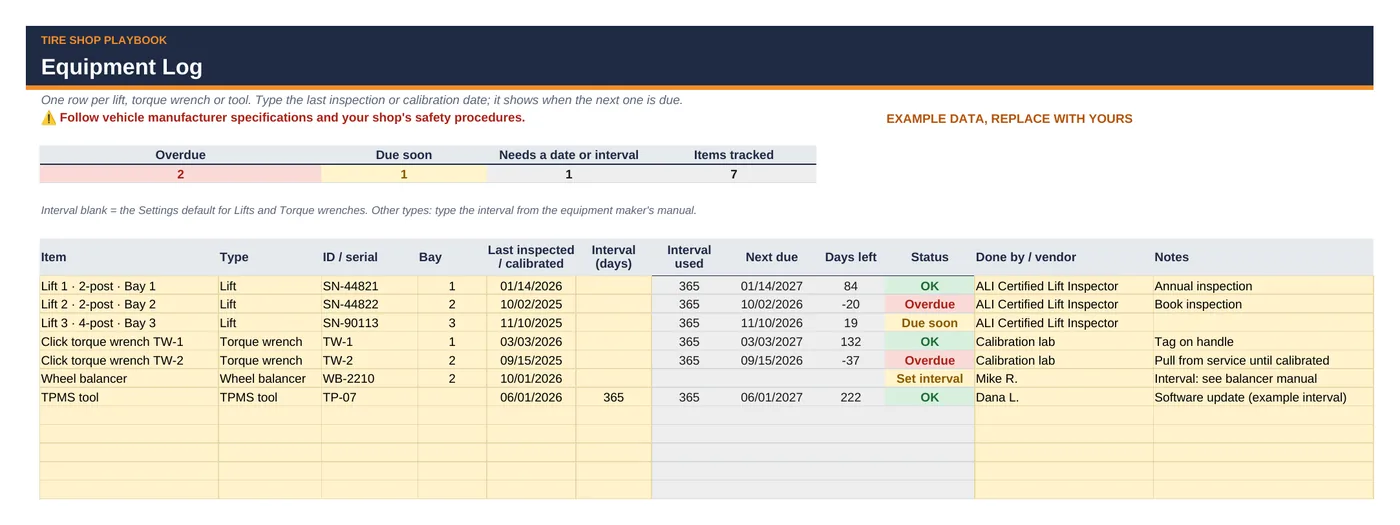
- Never miss a due date: lift inspections and torque wrench calibration show OK, Due soon or Overdue.
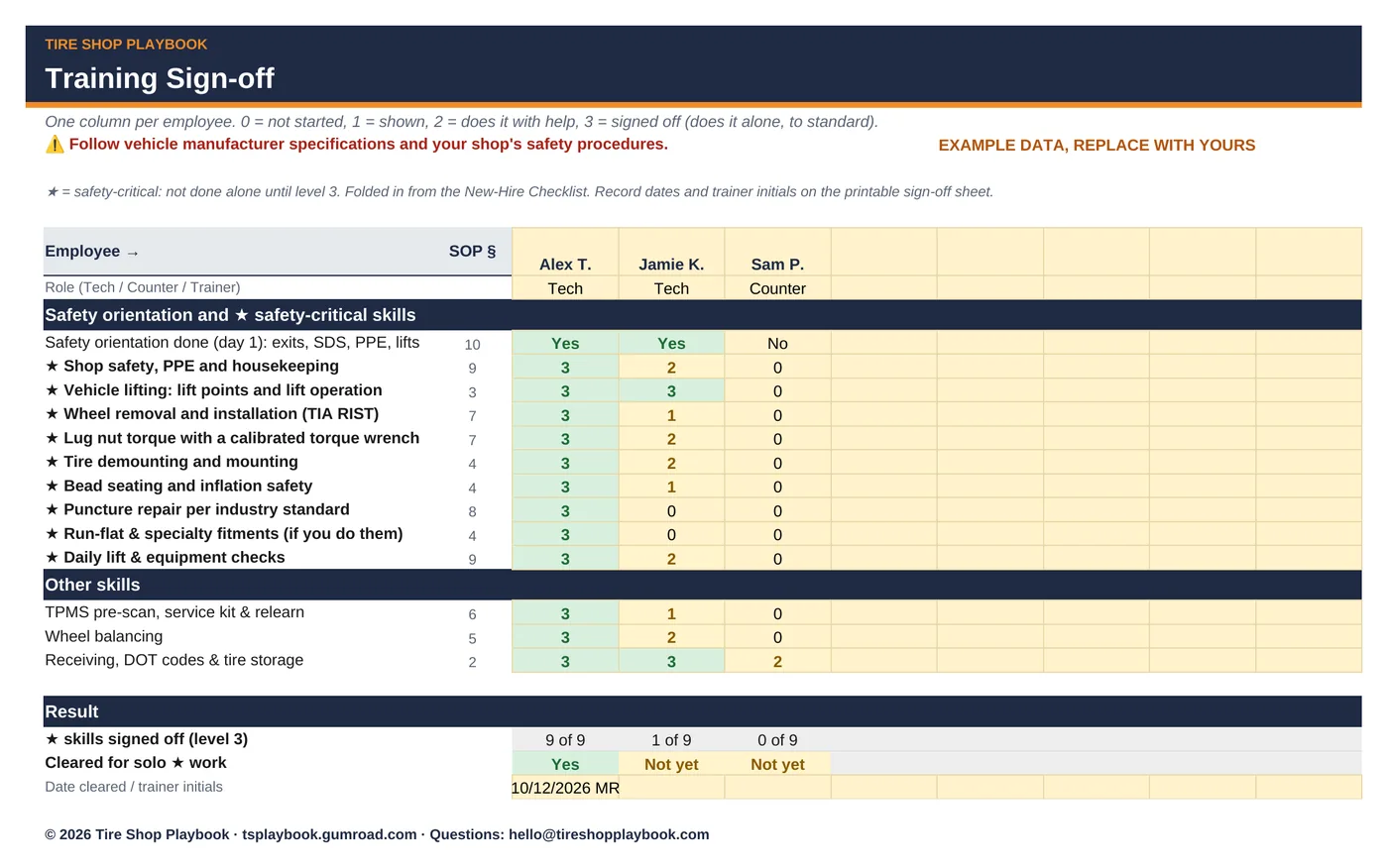
- Know who's cleared: levels 0 to 3 for each employee on each safety-critical (★) skill; "Cleared for solo ★ work" turns to Yes only when every one is signed off.
What's included
- SOP & Safety Manual:
tire-service-sop-safety-manual.docx(edit it) andtire-service-sop-safety-manual.pdf(7 pages). [Brackets] mark your shop's choices, and there's an optional "Reviewed and adopted by" sign-off line for your shop's qualified reviewer. - Safety Checklists:
tire-service-safety-checklists.docxand.pdf(4 pages): monthly lift check, daily equipment check, wheel-off job checklist, puncture repair checklist, new-hire safety sign-off. - Safety Log:
tire-service-safety-log.xlsxwith 6 tabs:- Start Here: a short how-to
- Settings: shop info, lift names (up to 8), due-soon warning, lift inspection and torque wrench calibration intervals
- Daily Checks: OK / NO / N/A for each lift and machine, every day of the month
- Equipment Log: last inspected/calibrated, next due, days left and status
- Training Sign-off: levels 0–3 per employee, ★ skills count and "cleared for solo ★ work"
- Issue Log: failed checks, tag-outs, repairs and back-in-service dates
- Includes a step-by-step Quick Start Guide (PDF):
tire-service-sop-safety-checklists-quick-start-guide.pdf, 6 pages, with annotated screenshots. - Example data in the Safety Log so you can see how it works. Replace it with your own.
- The Safety Log works in Google Sheets and Excel. No macros, no add-ons, no subscription.
Questions
Important: please read before use
The forms, procedures and checklists in this kit are templates, not legal advice. Have a local attorney adapt them to your state's laws and your business before use. They are general guidance and don't replace the vehicle, tire or equipment manufacturer's specifications and instructions, OSHA and state requirements, or proper training. No torque, inflation or repair values are provided: always use the manufacturer's specs. A qualified technician is responsible for every job, and Tire Shop Playbook is not liable for how the templates are used.
Why are there no torque or inflation numbers?
They differ by vehicle, wheel and tire. The only right number is the vehicle manufacturer's spec for that vehicle (and the tire or equipment maker's, where they set it). The manual tells your tech where to find it every time. Follow vehicle manufacturer specifications and your shop's safety procedures.
Is this OSHA compliance or certification?
No. It's a set of shop procedures and records that point to recognized standards. It doesn't replace TIA, ALI or equipment-maker training, and it isn't legal advice. OSHA 29 CFR 1910.177 covers servicing multi-piece and single-piece rim wheels on large vehicles. Check your federal and state OSHA obligations.
Can I change the procedures?
Yes, you should. Edit the Word files to match your lifts, changers, balancers and policies. Then have a local attorney adapt them, have your shop's qualified reviewer sign the "Reviewed and adopted by" line, and have the owner sign the revision box.
What intervals does the Safety Log use?
Editable defaults on Settings: lift inspection every 365 days (ANSI/ALI ALOIM calls for at least an annual inspection by a qualified lift inspector) and torque wrench calibration every 365 days (ISO 6789 guidance: 12 months or 5,000 cycles, whichever comes first). The due-soon warning is 30 days. Use your equipment maker's interval if it's shorter.
What age limits does the receiving section use?
Editable defaults, per manufacturer guidance: inspect from 5 years after manufacture, replace at 10 years, spares included (Michelin, Bridgestone, Continental). Some automakers (e.g. Ford) recommend replacement at 6 years. NHTSA says there's no federal age limit.
Does it work in Google Sheets and Excel?
The Safety Log does. Upload the .xlsx to Google Drive and open it with Google Sheets, or open it in Excel. Formula cells are locked in Excel (no password) and color-coded grey in Sheets, so type only in the yellow cells. The manual and checklists are Word files with PDF copies; they also open in Google Docs.
Refunds?
All sales are final. If a file doesn't work, email hello@tireshopplaybook.com and we'll make it right.
Sources (checked Oct 2026)
ALI, "Lifting It Right" and ANSI/ALI ALOIM (daily checklist, annual inspection by a qualified lift inspector); ALI Vehicle Lifting Points guide (autolift.org) · USTMA, Puncture Repair Procedures for Passenger and Light Truck Tires (ustires.org) · TIA ATS training, RIST, TPMS Relearn Guide (tireindustry.org) · OSHA 29 CFR 1910.177 and 1910.1200 · ISO 6789 (torque tool calibration) · NHTSA · Michelin, Bridgestone and Continental tire-age guidance.
A look inside
Screenshots with example data. Replace it with your own numbers.